Golden Week in Japan: The Real Meaning Behind Every Holiday
Every spring, Japan comes alive with a burst of energy unlike any other time of year. Streets fill with colorful streamers, parks overflow with picnic blankets, and the entire nation seems to exhale at once. This is Golden Week — Japan’s most beloved holiday cluster, running from late April through early May.
But Golden Week is not just a vacation. It’s a patchwork of four distinct national holidays, each carrying its own story, its own symbols, and its own emotional weight. If you’re visiting Japan during this period, understanding why these days exist will transform your experience from tourist to time traveler.
Here’s your complete guide to every holiday in Golden Week 2026 — what it means, how people celebrate, and what you can do to truly feel it.
Golden Week 2026: At a Glance
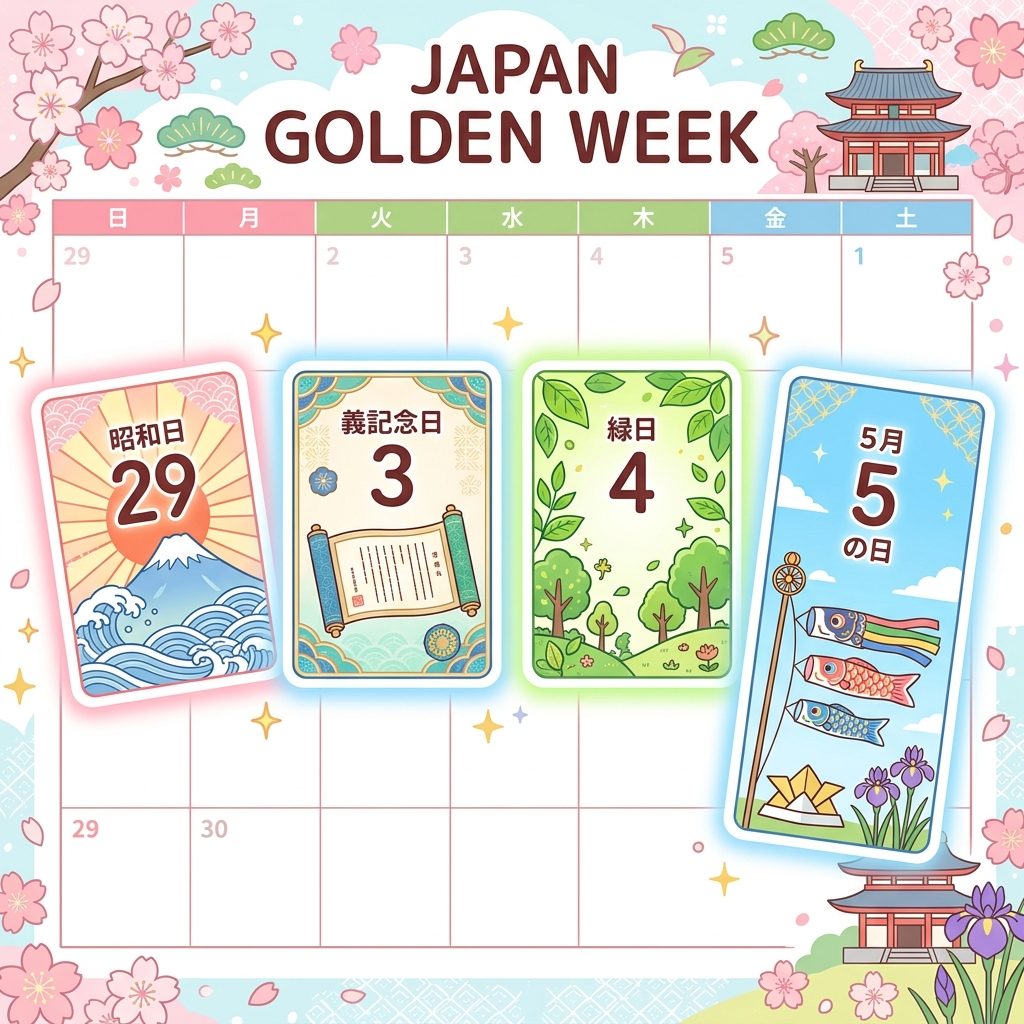
In 2026, the official holiday dates are:
- April 29 (Wednesday) — Showa Day (昭和の日)
- May 3 (Sunday) — Constitution Memorial Day (憲法記念日)
- May 4 (Monday) — Greenery Day (みどりの日)
- May 5 (Tuesday) — Children’s Day (こどもの日)
- May 6 (Wednesday) — Substitute holiday for Constitution Memorial Day
April 30 and May 1 are technically workdays, but many businesses close for the entire stretch, creating a near-continuous 8-day break for millions of Japanese people.
Holiday 1: Showa Day — April 29
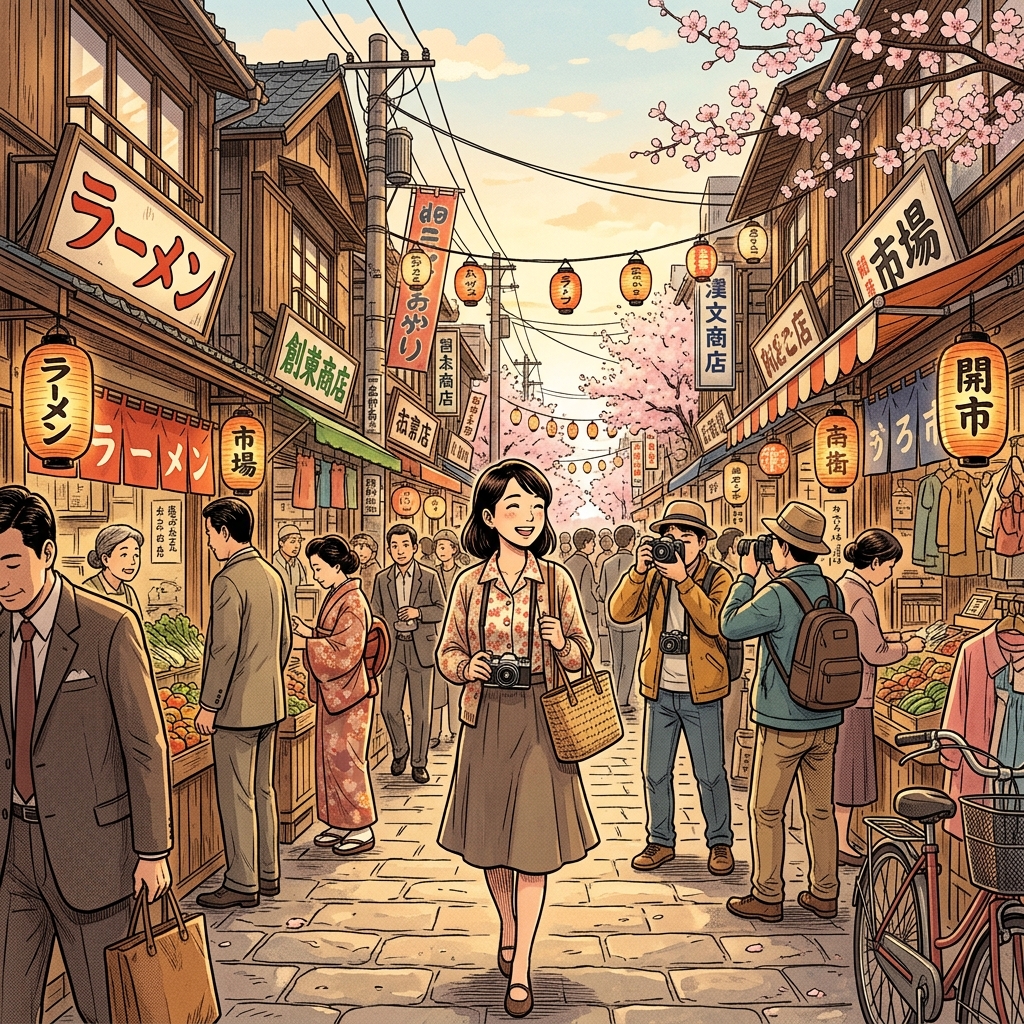
Reflecting on an Era That Shaped Modern Japan
Of all the holidays in Golden Week, Showa Day carries the most complex emotional weight. At its heart, it’s a day of reflection — not celebration.
April 29 marks the birthday of Emperor Shōwa, known to the outside world as Emperor Hirohito, who reigned from 1926 until his death in 1989. His era — 昭和 (shōwa), meaning “radiant harmony” — spanned 62 transformative years.
There’s a deep irony in that name. The early Shōwa era was anything but harmonious: Japan’s military expansion through Asia, the tragedies of World War II, the atomic bombings of Hiroshima and Nagasaki. Then came devastation. And then — in one of history’s most remarkable turnarounds — came rebirth.
The post-war Shōwa era produced what economists call the “Japanese economic miracle.” A nation in ruins became one of the world’s leading economies in just a few decades. Cherry blossoms gave way to skyscrapers. Buddhism gave way to baseball. The transistor radio gave way to the Walkman.
When Hirohito died in 1989, April 29 was initially repurposed as “Greenery Day” to honor his well-known love of nature and biology. But in 2007, the government formally renamed it Showa Day — a dedicated opportunity for all Japanese people to pause and contemplate that turbulent, defining era.
How to Experience Showa Day
There are no parades or fireworks. The day is quieter in spirit. Here’s how to feel it:
- Visit a Shōwa-era retro town (昭和レトロ): Areas like Yanaka in Tokyo or Kawagoe in Saitama have preserved the atmosphere of mid-20th century Japan — old shotengai shopping streets, wooden architecture, and a pace of life that feels lifted from a different time.
- Explore the Shōwa Museum (昭和館) in Kudanshita, Tokyo — a thoughtfully curated museum dedicated to the daily lives of people during the war and post-war periods.
- Spend the day in Showa Memorial Park (昭和記念公園) in Tachikawa, Tokyo — a vast, beautiful park built to celebrate the 50th anniversary of the Shōwa emperor’s reign. In late April, the park is blanketed in tulips and poppies.
Walking through a Showa-era shopping street on April 29, knowing the weight of history it carries, is one of the most quietly moving experiences Japan can offer a visitor.
Holiday 2: Constitution Memorial Day — May 3
The Day Japan’s Democracy Was Born
On May 3, 1947, Japan’s postwar constitution came into effect — and with it, the country’s transformation from an imperial state to a parliamentary democracy was complete.
This is Constitution Memorial Day (憲法記念日, Kenpō Kinenbi). While it may sound dry, this date represents one of the most profound shifts in Japanese society. And to truly understand modern Japan — its politics, its culture, its identity — you need to understand this document.
Japan’s 1947 constitution is extraordinary in one particular way: Article 9. In it, Japan renounces war “as a sovereign right of the nation” and pledges never to maintain war potential. It is the only major world power with such a constitutional commitment to pacifism, and it remains deeply debated to this day.
Every year on May 3, the National Diet Building in Tokyo holds a public open day. Advocacy groups set up stalls outside parliament discussing constitutional issues. It’s one of the rare moments when Japanese civic life becomes genuinely visible to visitors.
How to Experience Constitution Memorial Day
- Visit the National Diet Building (国会議事堂) — Japan’s parliament opens its doors to the public for free tours. Seeing the chamber where democracy was debated and built is extraordinary.
- Walk through Hibiya Park — This elegant Western-style park in central Tokyo often hosts public gatherings and events on this day.
- Read Article 9 — Seriously. It’s just a few sentences. And understanding why it matters to so many Japanese people will give you a lens through which to view many contemporary news stories about Japan.
Holiday 3: Greenery Day — May 4
A Day to Fall Back in Love with Nature
Greenery Day (みどりの日, Midori no Hi) is the most serene holiday of Golden Week. Its origin traces back, like Showa Day, to Emperor Shōwa — but through a different facet of his character.
Beyond his role as head of state, Hirohito was a passionate biologist and naturalist. He published numerous papers on marine biology, taxonomy, and ecology. When he died, many Japanese wanted to honor not just his reign but his love of the natural world — and so April 29 became Greenery Day. When it was later moved to May 4, the spirit remained: a national day to appreciate, protect, and be grateful for nature.
There are no fixed traditions. It’s delightfully open. The idea is simply to go outside, breathe the spring air, and reconnect with the earth.
How to Experience Greenery Day
- Early May is one of Japan’s most beautiful times to be outside. The cherry blossoms are gone, replaced by fresh green leaves, wisteria (藤), and the first summer flowers. The light in Japan in early May is extraordinary — warm but not blazing.
- Shinjuku Gyoen in Tokyo transforms in early May with stunning garden displays. Kameido Tenjin Shrine in eastern Tokyo holds its famous Wisteria Festival right around this time — arching tunnels of purple blooms reflected in the water.
- For the ambitious: hike a path in Nikko, explore the Iya Valley in Shikoku, or cycle along the Shimanto River in Kochi. Greenery Day is the universe gently reminding you that screens can wait.
There’s a Japanese concept — shinrin-yoku (森林浴), or “forest bathing” — that involves simply walking through a forest slowly and absorbing the atmosphere. Greenery Day is the ideal occasion to try it.
Holiday 4: Children’s Day — May 5
Carp, Samurai Helmets, and the Dream of Strength
Children’s Day is the most visually spectacular holiday of Golden Week — and the one that will stop you in your tracks the most often.
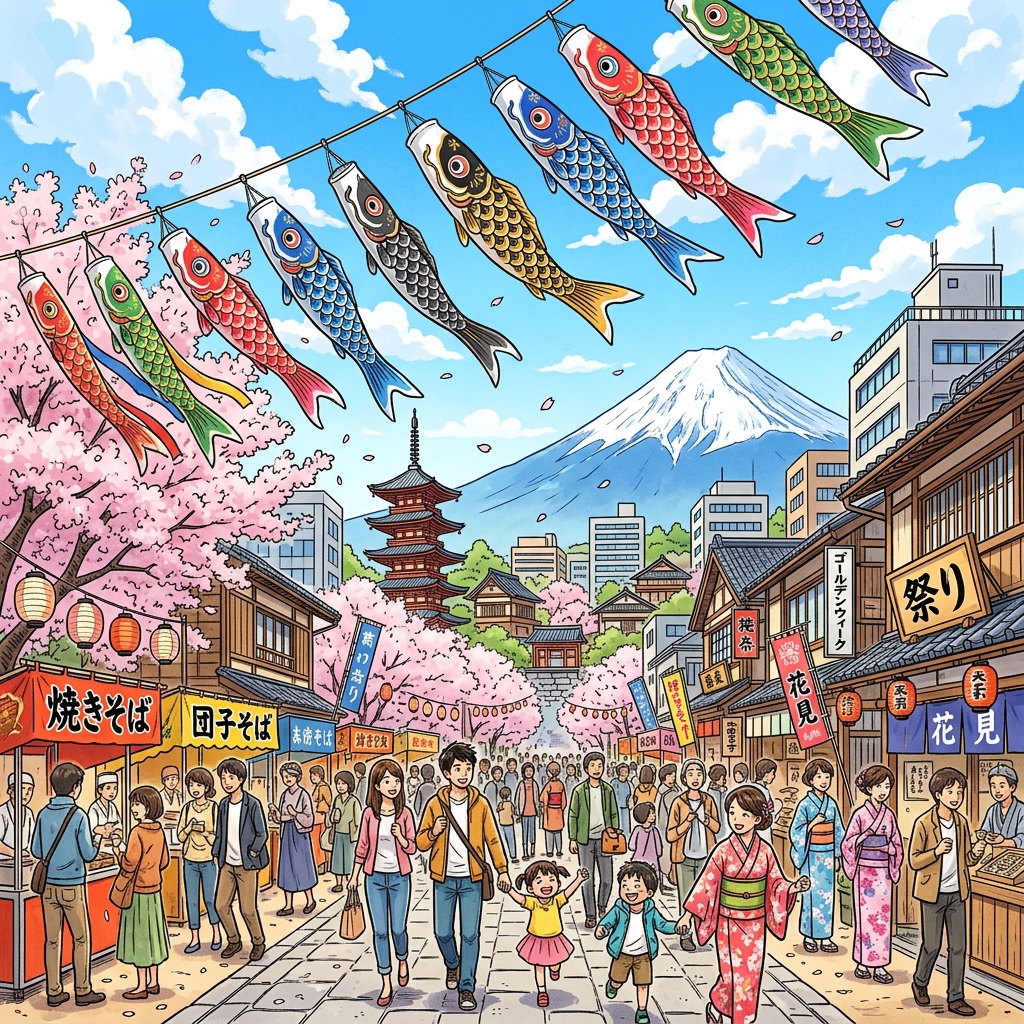
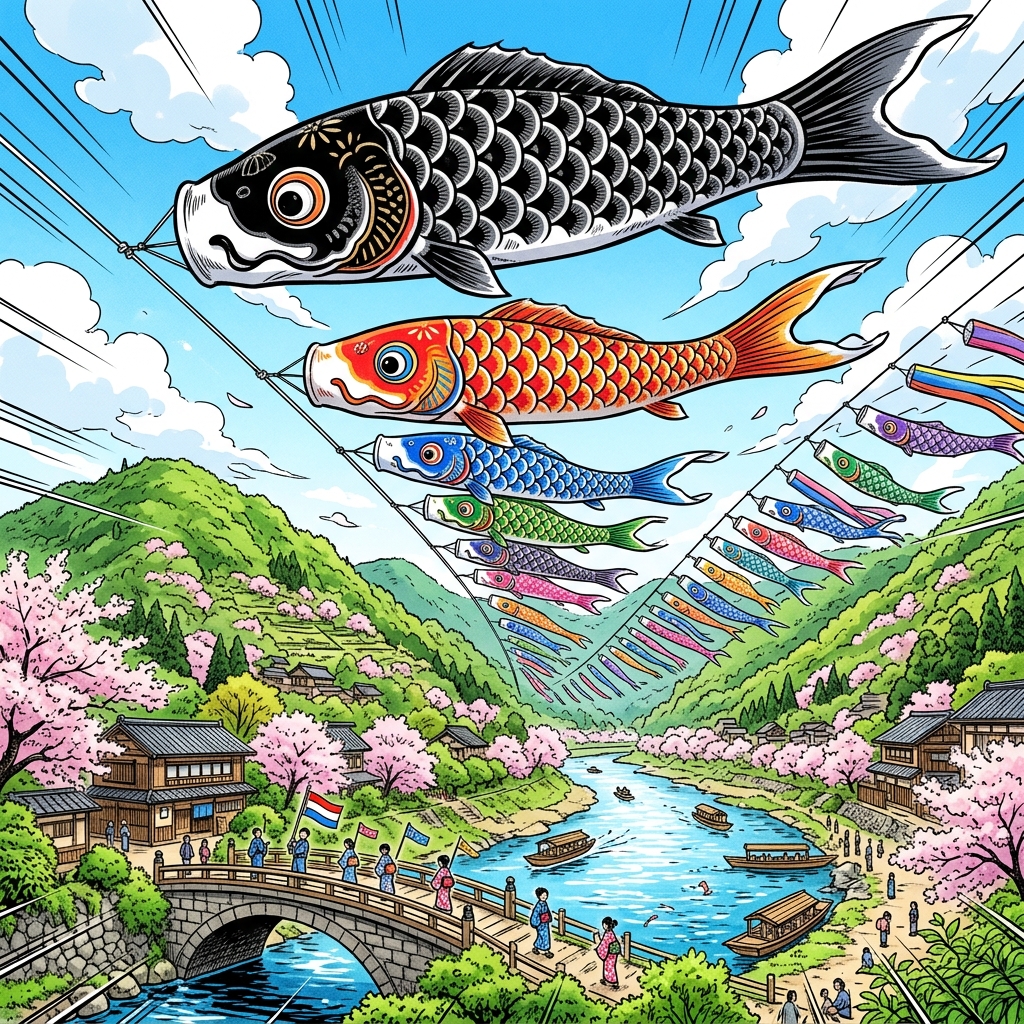
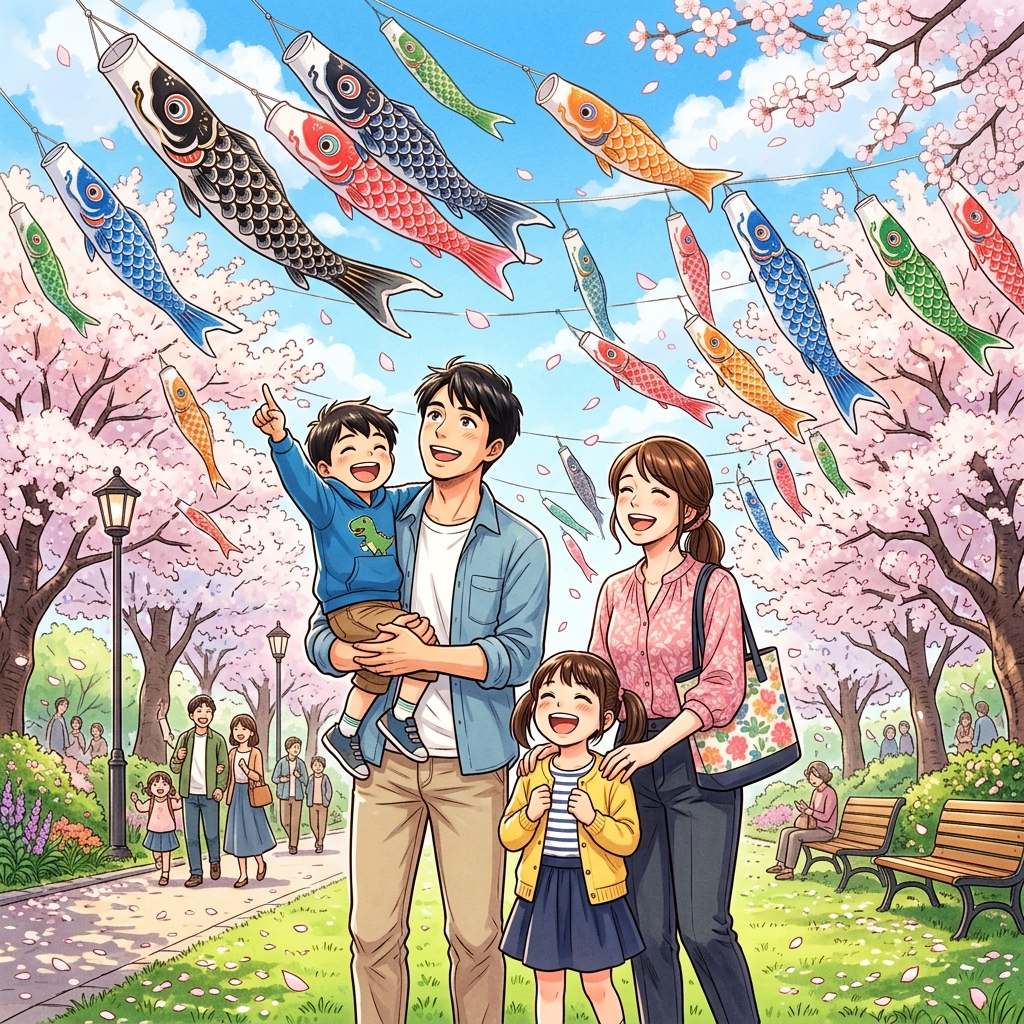
Walk through any Japanese neighborhood in late April or early May, and you’ll see them: enormous, colorful, fish-shaped streamers flying from rooftops, balconies, and poles. These are koinobori (鯉のぼり) — carp streamers — and they are one of the most beautiful sights in all of Japan.
The Legend of the Koi
The carp (koi) is celebrated in both Japanese and Chinese culture for one defining trait: its stubborn, relentless will to swim upstream. An ancient Chinese legend tells of a carp that swam upstream the Yellow River, battled through rapids, and finally leapt through the Dragon Gate — transforming into a magnificent dragon. It became a symbol of perseverance, ambition, and the ability to overcome any obstacle.
On Children’s Day, families fly koinobori to express their hopes for their children: grow strong, keep going no matter what, and one day soar like a dragon.
The streamers fly in a specific order:
- Black (magoi) — the father, largest and highest
- Red or pink (higoi) — the mother
- Smaller colorful streamers below — one for each child
A family with three children will fly five koinobori total. It’s an entire family portrait, written in wind.
Kabuto: The Warrior’s Wish
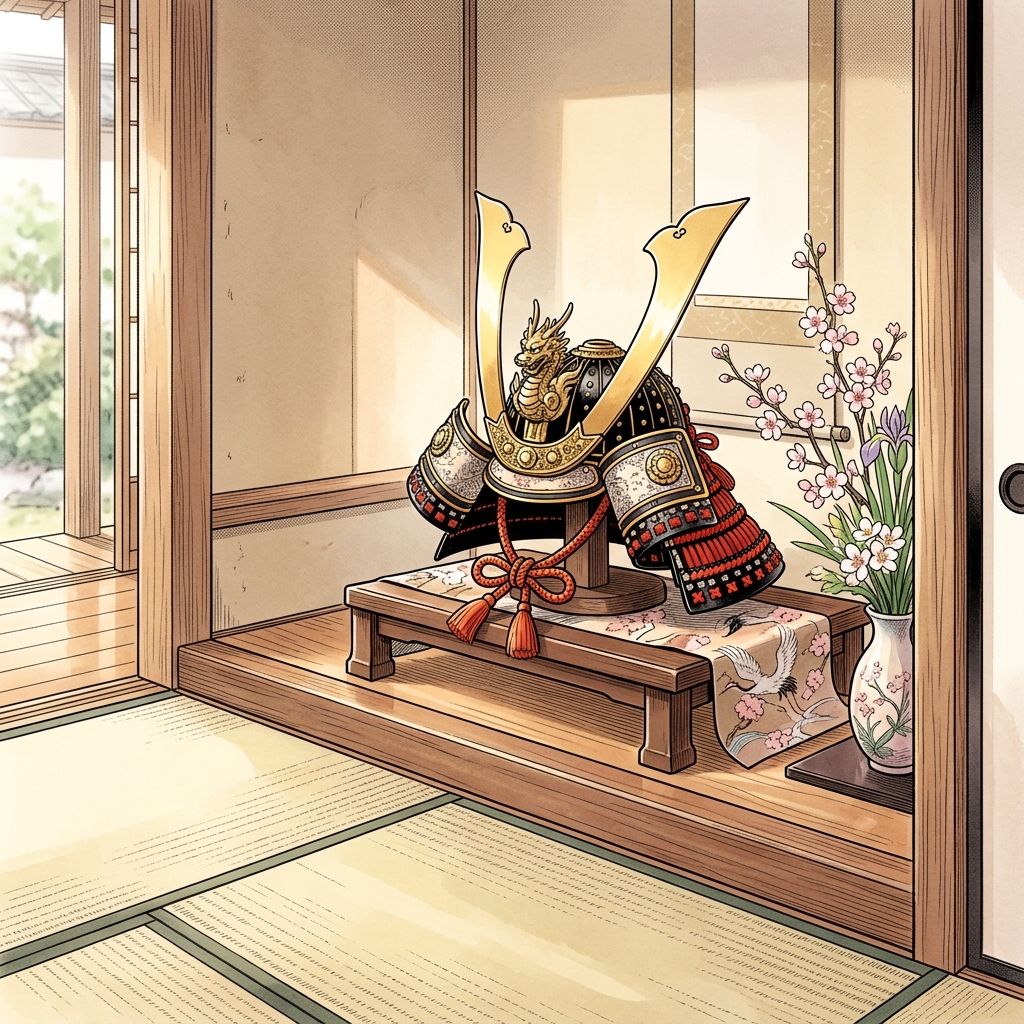
Inside Japanese homes during this season, you’ll often find a kabuto — a decorative samurai helmet — displayed in the entrance hall or living room. These aren’t antiques (though some are); they’re ceremonial objects passed down or purchased to symbolize the same protective wish the koinobori expresses outside.
The kabuto represents courage, discipline, and the samurai’s code of honor. Parents display them as a blessing: may my child grow up with strength, integrity, and the spirit to face whatever comes.
Kashiwa Mochi: The Sweet Taste of Continuity
The food of Children’s Day is kashiwa mochi — soft rice cakes filled with sweet red bean paste and wrapped in an oak leaf. The oak leaf is the key.
In Japan, the oak (kashiwa) holds its old leaves through winter, refusing to drop them until new leaves push them off in spring. For the Japanese, this became a metaphor for family continuity: the old generation does not step aside until the next generation is ready to take its place. Eating kashiwa mochi is a ritual of continuity — of wishing the family forward into the future.
How to Experience Children’s Day
- Sagamihara City’s Giant Koi Festival near Tokyo flies over 1,000 koinobori across a river valley — one of the most photographed scenes in Japan during Golden Week. Equally impressive: Showa Memorial Park in Tachikawa strings hundreds of koinobori over its tree-lined avenues.
- Buy kashiwa mochi at any wagashi (traditional sweets) shop from late April. Eat it in a park. Think about continuity.
- Visit a samurai museum or dojo — Many cultural centers hold special kabuto-making workshops for Children’s Day. Even as a visitor, crafting your own ceremonial helmet is an unforgettable experience.
Surviving Golden Week as a Visitor: Practical Tips
Golden Week is spectacular — but it’s also the most crowded time of year in Japan. Here’s how to navigate it wisely.
The Crowd Reality
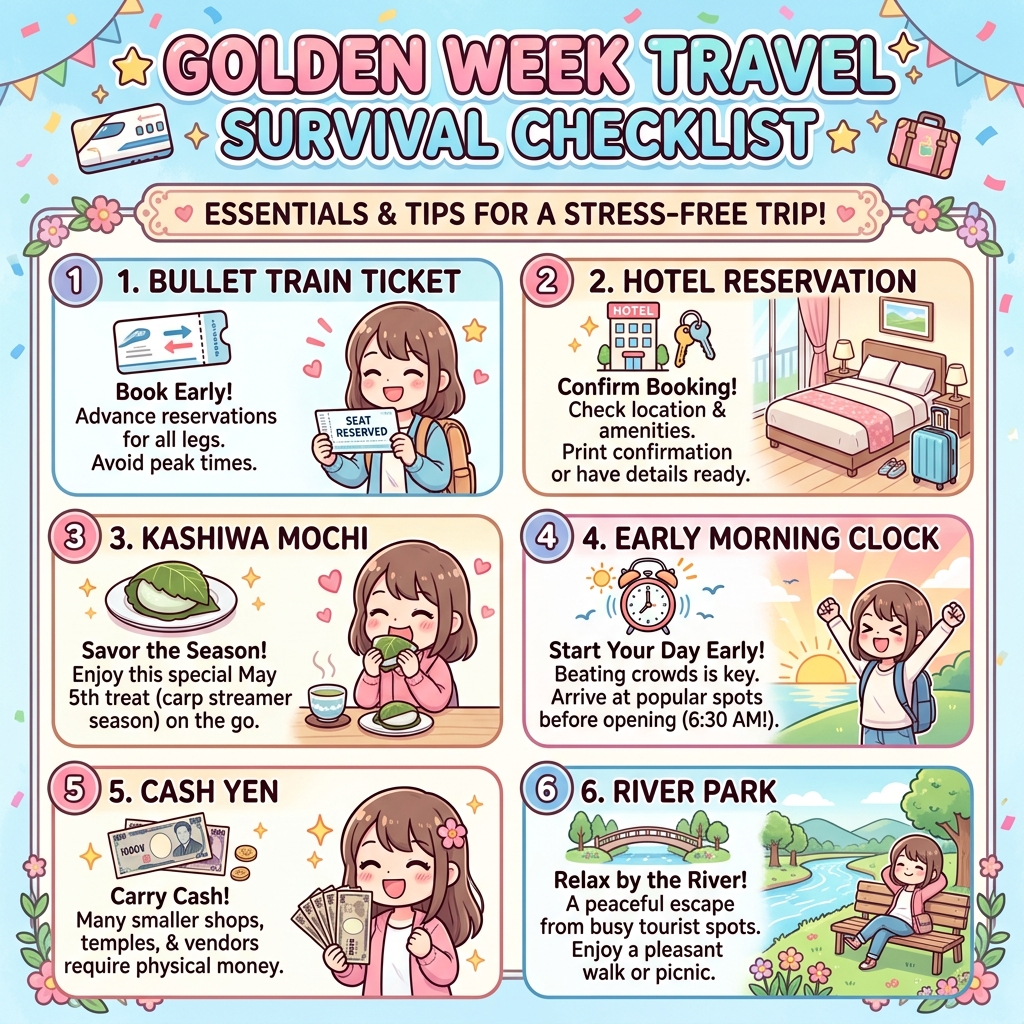
On peak travel days — especially April 29 (the first holiday) and May 2–5 — Shinkansen trains, airports, and highways operate at maximum capacity. In 2026, the busiest single day is expected to be May 2 (Saturday), the day before Constitution Memorial Day. Book your inter-city travel months in advance.
Timing Tricks
- Go early. Major parks and shrines open at 9 AM — or earlier. Arriving at 8:30 AM gets you 90 minutes of relative quiet before the masses.
- Midweek is calmer. In 2026, the holidays fall on April 29, May 3, 4, 5, and 6. The “gap” days of April 30 and May 1 are technically workdays, making them the most peaceful days of the stretch for tourism.
- Late evening is underrated. Department stores and markets stay open late during Golden Week. Exploring at 7–9 PM, when families have gone home for dinner, is a completely different (and delightful) experience.
Hidden Gems to Escape the Crowds
- Kamikawa, Saitama — Famous for its own koinobori festival, far less crowded than city parks
- Matsue, Shimane — A castle town that rivals Kyoto in history, with a fraction of the tourists
- Iya Valley, Shikoku — Remote mountain scenery, vine bridges, and complete serenity
- Hirosaki, Aomori — If late cherry blossoms are your goal, Hirosaki often peaks in early May — a full month after Tokyo
Practical Checklist
- Book Shinkansen seat reservations at least 2–3 months ahead
- Reserve accommodation — prices spike 2x–3x during Golden Week
- Carry cash: rural and festival vendors often don’t take cards
- Check opening hours: smaller shops and some banks may close for the full week
- Download the Japan Official Travel App for real-time crowd forecasts
The Deeper Gift of Golden Week
For visitors, Golden Week can feel overwhelming — a peak-season crunch of crowds, costs, and logistics. But beneath the surface, it’s something else entirely: a week in which an entire society simultaneously turns its eyes toward its own past, its democratic foundations, the natural world, and the children who will carry it all forward.
Each holiday is a layer. Peel them back slowly, and you’ll find a country that has thought very carefully about what it wants to remember — and why.
Happy Golden Week. Take it all in.
🎏 Golden Week Quiz
How well do you know Japan’s most iconic holiday week?