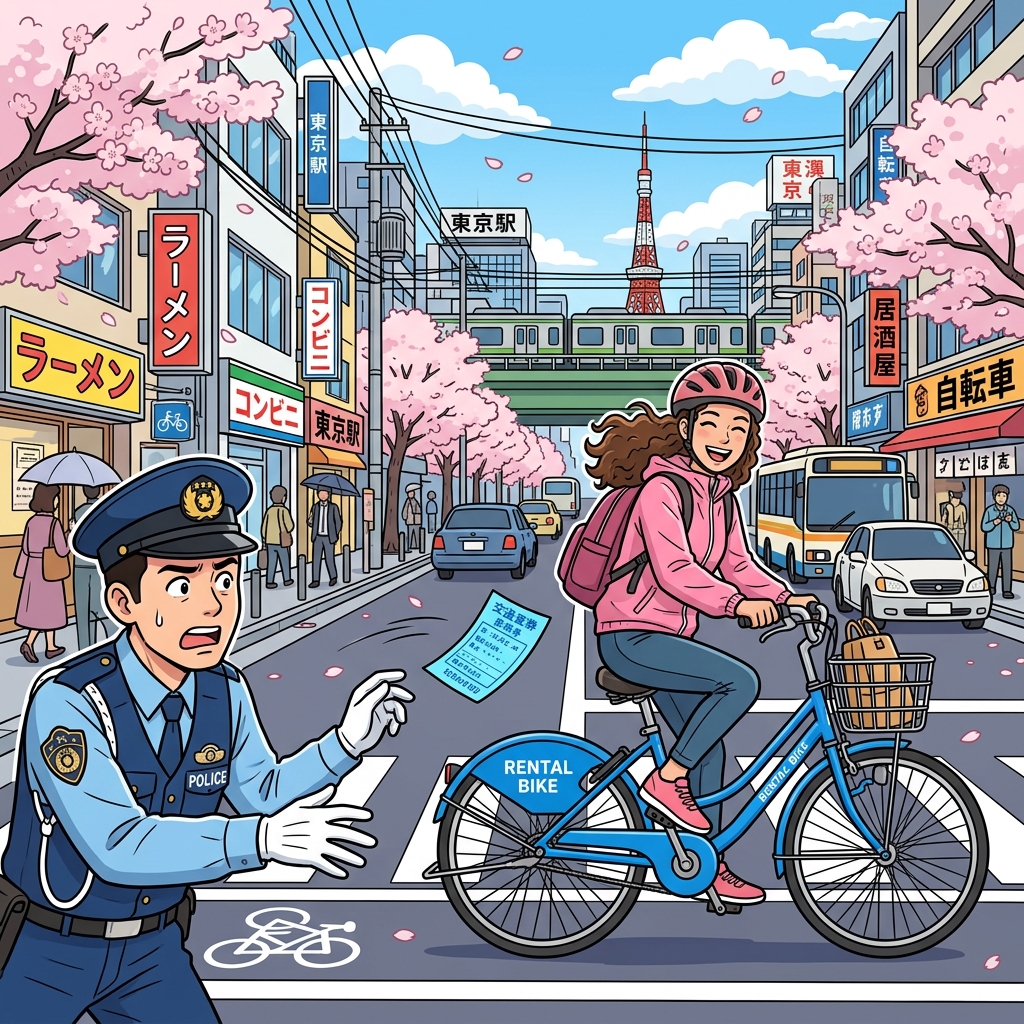
This article is illustrated with AI-generated manga-style artwork. All illustrations are clearly fictional and created for educational purposes.
Renting a bike to explore Japan? Great idea — but there’s something you absolutely need to know first.
As of April 1, 2026, Japan overhauled how bicycle traffic violations are handled. The new “Blue Ticket” system (ao-kippu, 青切符) allows police to issue on-the-spot, fixed fines for over 113 types of cycling offenses. And yes — this applies to every cyclist aged 16 and older, including tourists and short-term visitors.
This is a significant shift. In the past, minor violations usually resulted in a verbal warning. That era is over. This guide breaks down every important detail so you can enjoy Japan’s incredible cycling culture without any unwanted surprises.
- What Changed, and Why?
- Understanding the Two-Tier System: Blue Ticket vs. Red Ticket
- Complete Fine List: What Will Cost You Money
- Rules You Must Know Beyond the Fine List
- What Happens If You Receive a Blue Ticket?
- Quick Checklist Before You Ride
- Where to Find Official Information
- Final Thoughts
- 🎯 Blue Ticket Challenge — Test Your Knowledge!
What Changed, and Why?
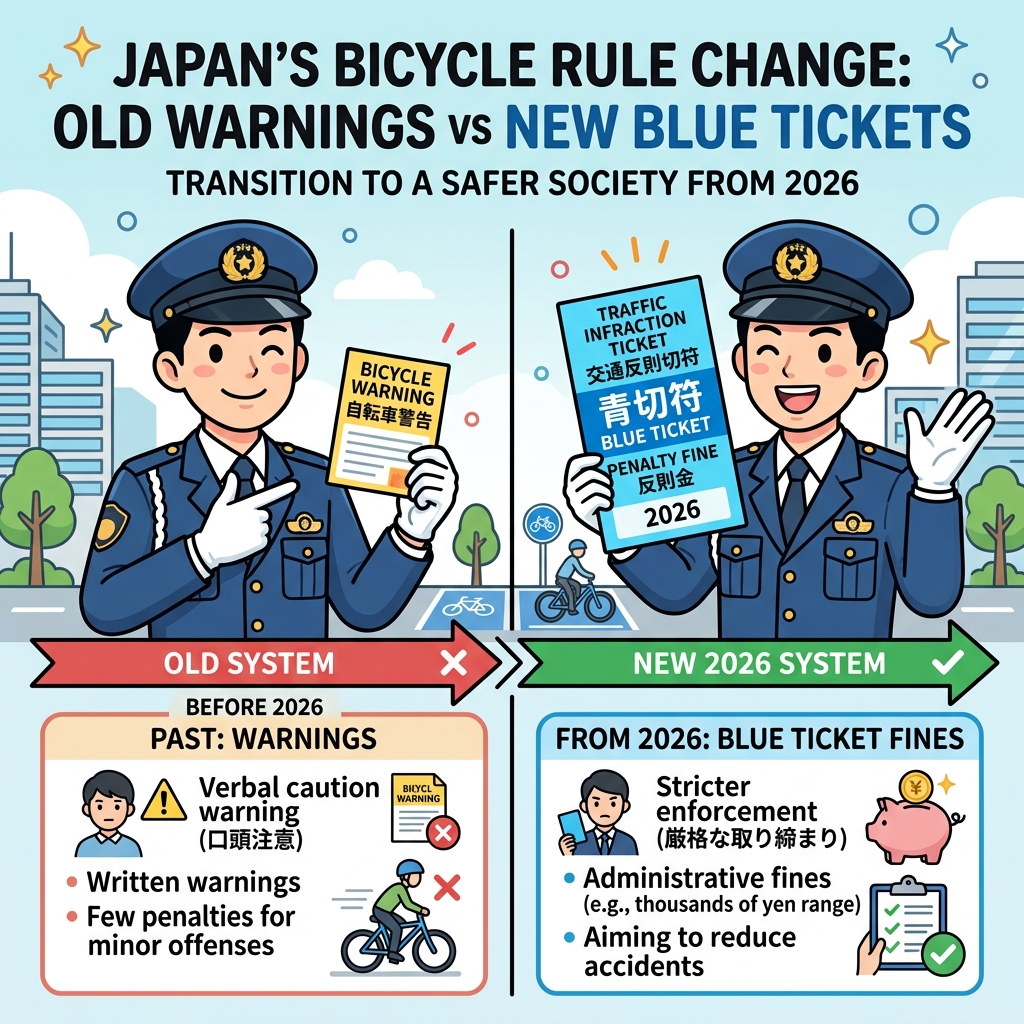
The new rules come from Japan’s Road Traffic Act revision, which came into force on April 1, 2026.
Before this date, the only enforcement tools available to police were:
- A verbal warning or guidance (shidou keikoku)
- A “Red Ticket” for serious offenses, leading directly to criminal proceedings
There was no middle ground. Minor violations often went unpunished in any meaningful way.
The new Blue Ticket system bridges that gap — similar to how Japan has long handled car and motorcycle violations. Now, cyclists face real financial consequences for everyday infringements.
The stated goals of the reform are:
- Reduce the number of bicycle-related traffic accidents
- Create consistent, fair enforcement of cycling laws
- Streamline the legal process for minor violations
Understanding the Two-Tier System: Blue Ticket vs. Red Ticket
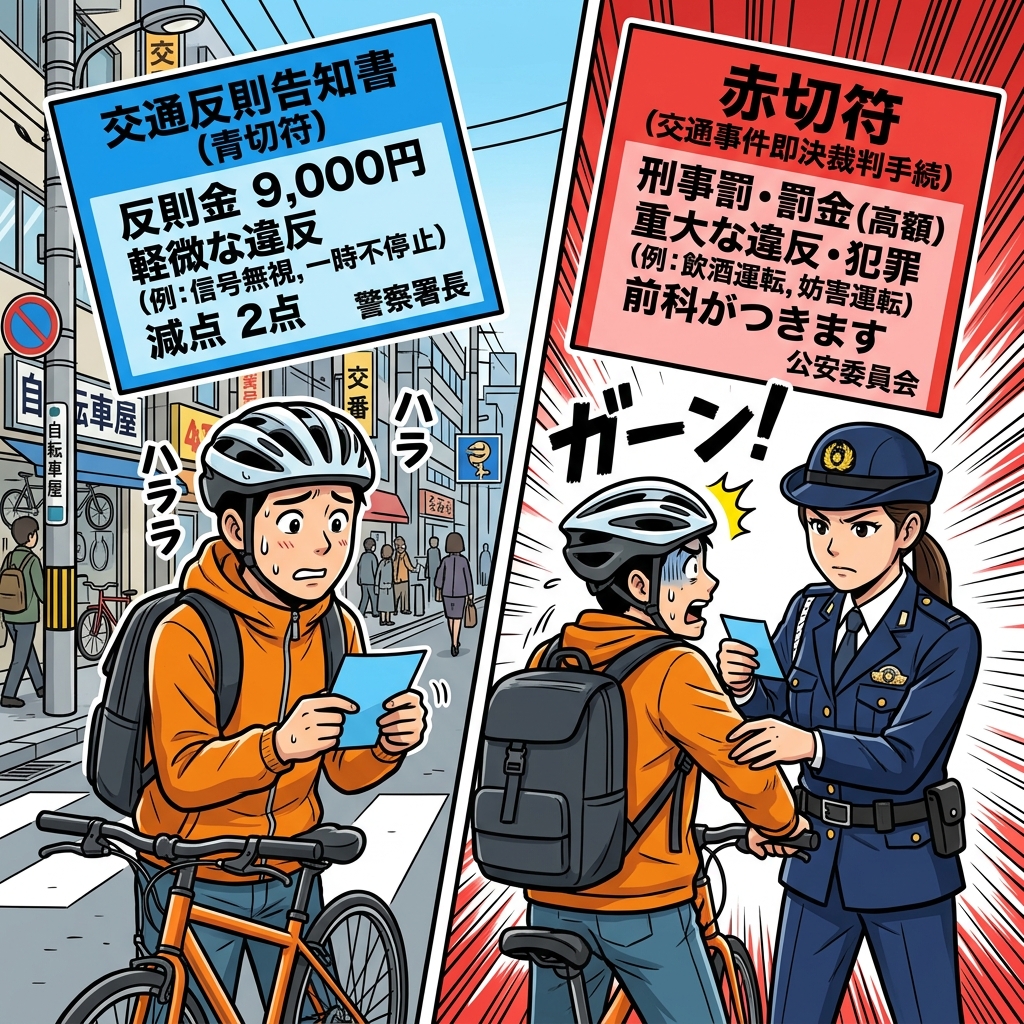
Blue Ticket (青切符) — For Minor Violations
If a police officer catches you committing one of the 113+ covered offenses, you will receive a Blue Ticket (a formal notice) along with a payment slip.
- You have approximately one week to pay the fine at a bank or post office
- Once paid, the matter is closed — no criminal record, no court appearance
- Applies to cyclists aged 16 and older
- Cyclists under 16 generally receive guidance and warnings, not fines
Red Ticket (足切符) — For Serious Violations
Some violations go straight to criminal proceedings regardless of the new system.
These include:
- Cycling under the influence of alcohol (drunk cycling)
- Aggressive or obstruction-causing riding (妨害運転)
- Causing an injury accident while cycling
A Red Ticket can lead to police investigation, prosecution, and potential imprisonment or heavy court fines. There is no simple “pay and move on” option here.
Complete Fine List: What Will Cost You Money
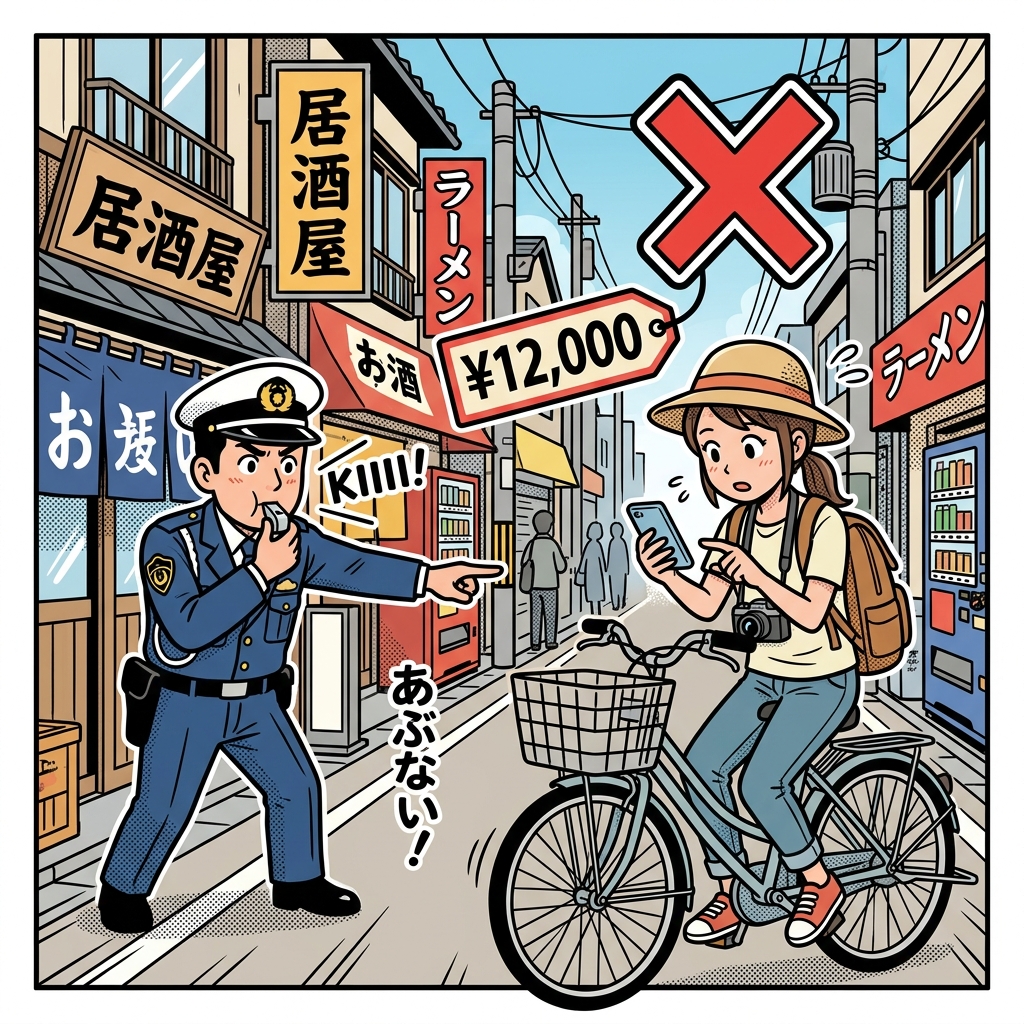
The Blue Ticket covers 113 types of violations. Here is a detailed breakdown of the most important ones:
Highest Fine
Using a smartphone while riding: ¥12,000
This is the single most expensive common fine under the new system. It doesn’t matter if you’re looking at Google Maps, reading a message, or just glancing at the screen — if you are holding or using your phone while riding, you can be fined.
Travel tip: Download offline maps before your trip and plan your route before you start pedaling. If you use a handlebar mount, lock your screen while riding.
¥7,000 Fines
Entering a railroad crossing while the barrier is down: ¥7,000
Japan has countless level crossings, especially outside city centers. When the alarm sounds and the barriers drop, stop completely and wait. Never try to squeeze through — trains move fast and there is zero margin for error.
¥6,000 Fines
Running a red light: ¥6,000
Every red light means stop. Period. This applies even if the road looks empty or you’re in a hurry.
Riding on the wrong side of the road (riding on the right): ¥6,000
Japan drives on the left. Bicycles must do the same. Riding against traffic is one of the most common mistakes foreign visitors make — and one of the most dangerous.
Dangerous riding on the sidewalk: ¥6,000
In Japan, cyclists are expected to ride on the road, not the sidewalk, in most situations. Sidewalk cycling is only permitted where a specific sign (自転车通行可) is posted. Even then, pedestrians always have priority, and you must ride slowly and carefully.
¥5,000 Fines
Failing to stop at a stop sign: ¥5,000
Look for red inverted-triangle signs reading “止まれ” (Tomare) — these are stop signs. You must come to a complete halt, even if the intersection looks clear.
Riding with an umbrella (kasa-sashi unten): ¥5,000
This is more common than you might think! Holding an umbrella with one hand while steering with the other is against the rules. If it rains, use a rain jacket or pack a poncho instead.
Wearing earphones that block surrounding sound: ¥5,000
If you’re wearing headphones or earbuds in both ears and can’t hear traffic, emergency vehicles, or people around you, that’s a violation. Use one ear only, or choose open-ear audio if you need music.
Riding without lights at night: ¥5,000
You must have a functioning front light switched on after dark. A rear reflector is also required. Most rental bikes come equipped with both — but always double-check before riding at night.
¥3,000 Fines
Carrying an extra passenger (illegal riding double): ¥3,000
Most standard adult bicycles are not permitted to carry passengers. Unless the bike is specifically designed for two people (with a proper child seat and registration), don’t carry anyone on the back or front.
Riding side-by-side (heikō chūsha): ¥3,000
You might want to ride next to your travel companion for a chat, but cycling abreast is not allowed on regular roads. Ride single-file.
Rules You Must Know Beyond the Fine List
These are legal requirements that, while sometimes enforced under different categories, are essential for safe and legal cycling in Japan.
Always Ride on the Left Side of the Road
Bicycles must travel in the same direction as motor traffic, on the left side. This is the foundational rule of Japanese road use. If you only remember one thing from this article, make it this.
Helmets: Strongly Recommended, Not Mandatory for Adults
As of 2026, wearing a helmet is not legally required for adults and there is no fine for riding without one. However, the National Police Agency (NPA) and the Japanese government strongly encourage all cyclists to wear one.
If you are in an accident and were not wearing a helmet, it can affect your insurance compensation.
Always accept a helmet if one is offered at the rental shop.
Drunk Cycling: Never Do It
This falls under the Red Ticket category and is treated with extreme seriousness. As of November 2024 (a separate reform that preceded April 2026’s changes), the penalties for drunk cycling are:
- Up to 3 years in prison or a fine of up to ¥500,000
- The person who provided the bicycle can also be penalized
- Even the person who gave you the alcohol can face up to 2 years in prison or a ¥300,000 fine
This is not minor. Don’t drink and cycle in Japan. Ever.
E-Bike Rules
Pedal-assist e-bikes (the most common kind available for tourists) are legally classified as standard bicycles. All of the rules above apply equally.
You do not need a driver’s license to ride a standard pedal-assist e-bike.
High-powered electric bikes that classify as mopeds or motor vehicles are a different matter and do require a license. Always confirm the classification with your rental provider.
What Happens If You Receive a Blue Ticket?
Stay calm. Follow these steps:
- The police officer explains the violation and hands you a Blue Ticket and a payment notice
- Pay the fine at any bank or post office by the deadline (typically about one week)
- Keep your receipt as proof of payment
- Once paid, the matter is fully closed — no criminal record
If you don’t pay: The case may be escalated to criminal proceedings. As a tourist who may leave the country, this could create serious complications for re-entry to Japan in the future.
Quick Checklist Before You Ride
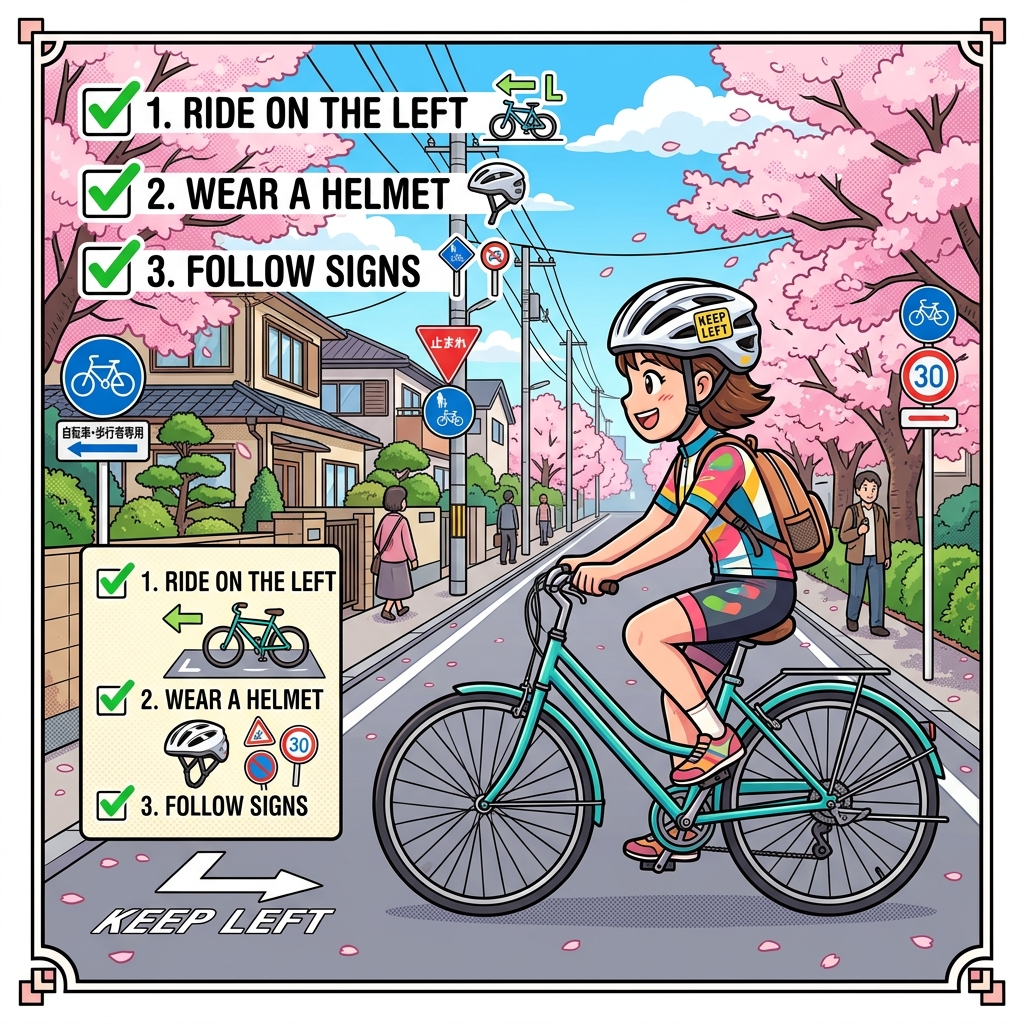
Use this as your pre-ride reminder every time:
- Lights tested and working (if riding after dark)
- Helmet on (strongly recommended)
- Phone put away — route checked in advance
- Sober
- Riding on the left side of the road
- No extra passenger on the back
- Earphones out (or one ear only)
- Rain jacket packed if weather is uncertain
Where to Find Official Information
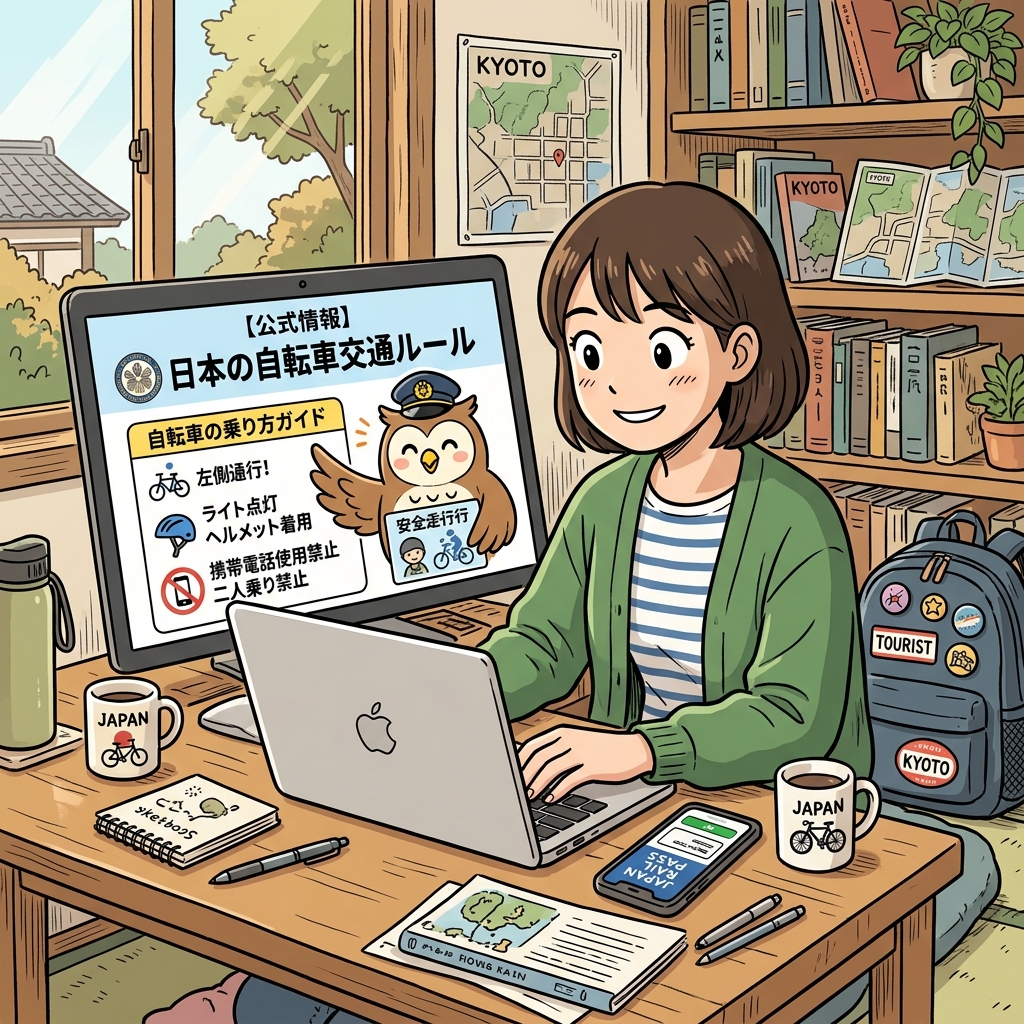
The rules described in this article are accurate as of April 2026, but laws can change and regional enforcement may vary. We strongly encourage all visitors to consult the official sources before cycling in Japan.
National Police Agency (NPA) of Japan — Bicycle Safety Portal:
https://www.npa.go.jp/bureau/traffic/bicycle/index.html
The NPA’s site includes downloadable guides in multiple languages and the full list of violations covered by the Blue Ticket system.
Official Japanese Government Online:
https://www.gov-online.go.jp/
For general information about updated traffic laws and public safety announcements.
As cycling regulations can vary by prefecture and municipality, checking with your local tourist information center or police box (koban) for area-specific guidance is also a good idea.
Final Thoughts
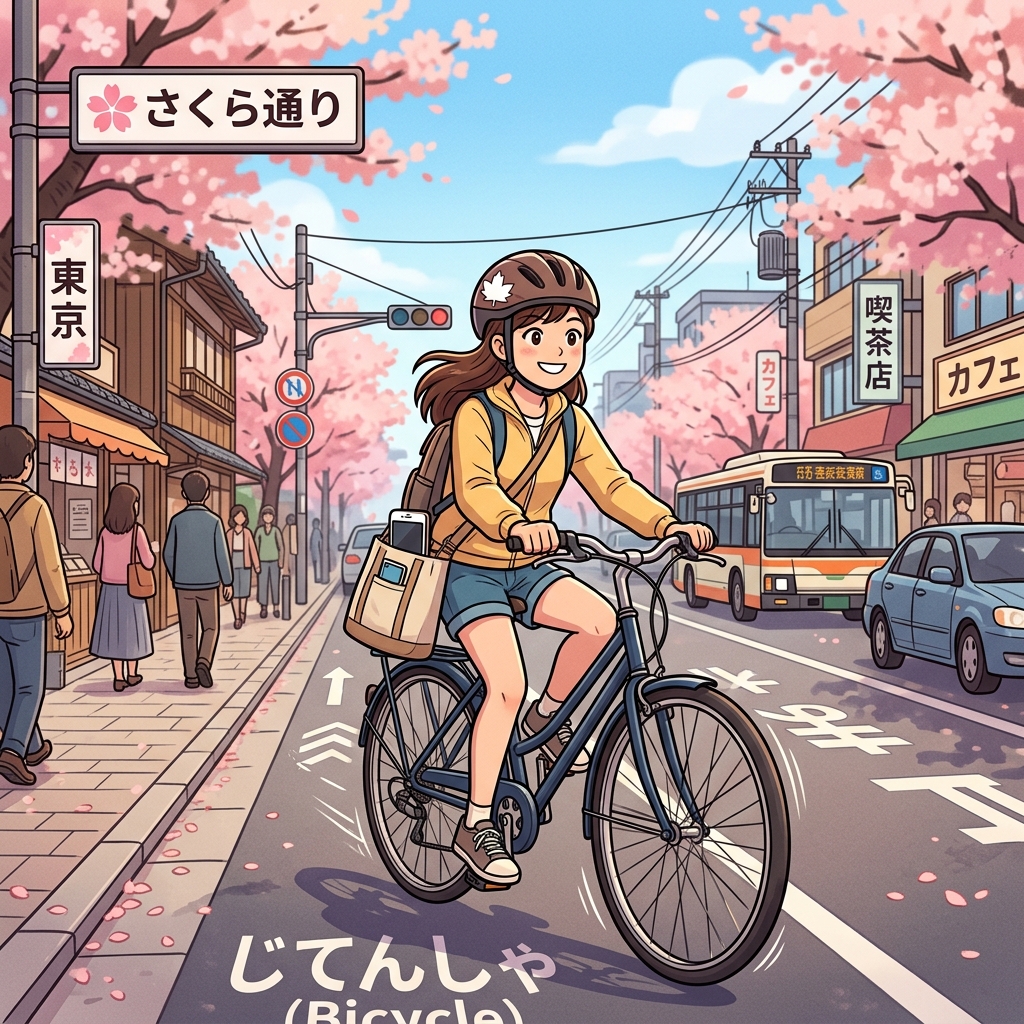
Japan is genuinely one of the best countries in the world for cycling. Clean streets, amazing scenery, incredible food just around every corner — a bicycle lets you discover a Japan that tour buses simply can’t reach.
The new Blue Ticket system is not designed to catch tourists off guard. It is designed to make roads safer for everyone. Follow the rules, ride mindfully, and cycling in Japan will be one of the highlights of your trip.
Happy riding — and welcome to Japan!
Disclaimer: This article is for informational purposes only. Regulations may be updated. Always verify with the official NPA website for the latest rules.
🎯 Blue Ticket Challenge — Test Your Knowledge!
Think you know Japan’s new bicycle rules? Take this quick quiz and find out!
Japan Bicycle Rules Quiz
Test yourself on Japan’s new Blue Ticket rules (April 2026)
📌 Key Rules to Remember
- Always ride on the left side of the road — never on the right.
- Smartphone use while riding = ¥12,000 fine. Plan your route before you start.
- Sidewalks are generally off-limits for cyclists — use the road.
- Ride without lights at night = ¥5,000 fine. Always check your front light.
- Red light = stop. Stop sign = stop. No exceptions.
- Drunk cycling is a criminal offense — not a simple fine.
- Helmets strongly recommended (not legally mandatory for adults).
⚠️ Rules may change. Always verify with official sources:
🚔 National Police Agency — Bicycle Safety Portal 🏛️ Official Japanese Government Online